Showing posts with label construction. Show all posts

Monday, January 26, 2015

War Company surcoats

Sometimes projects take on a life of their own in crazy ways. A number of years back, I ran a sewing day to assembly line surcoats for the Bryn Gwlad War Company. We finished off a decent number of surcoats (maybe 6 or 7?) with a team of five people. That kind of efficiency is possible with a well-run assembly line because you have lots of unskilled labor doing the time consuming things like ironing and cutting. This leaves your skilled sewing folks to do their work.  

 So.... it became clear recently that we needed another batch of surcoats and I volunteered to host and run the assembly line. I decided that this time I would teach a few people how to run one of these things so that we could replicate institutional memory. ISO compliance maybe? Anyway, as I started putting together checklists and spreadsheets, this thing kept getting bigger. It turned out that we really, really needed surcoats.

With two deputies, we hosted 24 people over two days of non-stop work.  People showed up and worked hard.  I took deep breaths and trusted my skilled labor and leaned heavily on my deputies and a couple of other logistics helpers.  There were 6 ironing boards, 2 sergers, and 6 sewing machines in action, along with lots of people tracing designs and cutting pieces. The charts and checklists appear to be working.
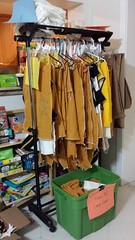
  Progress after day 2

This is twenty surcoats in progress on a hanging rack. They are labeled and filed according to their position in the pipeline. It's like a cross between filing cabinet and a wardrobe. This sewing day turned into a weekend worth of baronial barn raising. We had two days of madness and accomplished a ridiculous amount of work.

  Queued pieces

 The surcoats are all appliqued, so there are a lot of pieces. We have yellow halberds on black stripes that go on one side and black stars that go on the other side. The picture above is our piles of cut applique pieces in progress. These are all pieces that are waiting to go on surcoats next weekend.

Next weekend, we should have surcoats coming out the assembly line finished, so more pictures to come.  For now, my logistics team will spend the week trying to figure out how to most efficiently keep the line moving as we roll along.  Also, we will be appliqueing a lot of halberds.....

Tuesday, September 2, 2014

Generally busy

I'm juggling a number of projects with a variety of goals and the last couple of weeks have been a bit of progress on everything.

IMG_0812

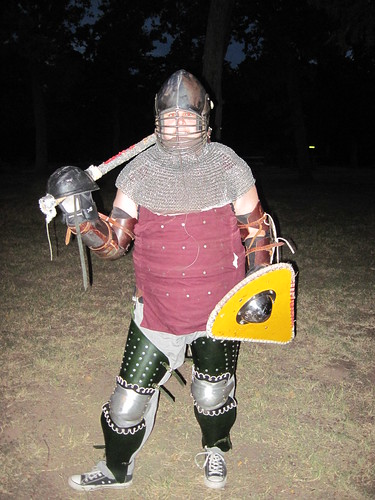
Here I am modeling the latest in my armor. My leg armor is coming along and is in a wearable state, although it still needs more work to be truly finished. I also have a new helm from Master Max and a new aventail that Sir Ysfael hung for me. After a long hiatus, I am finally back in the fight.

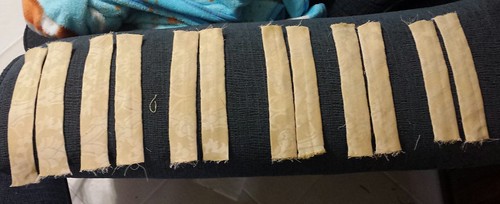
Six pair of hanger loops starched and ready to sew onto the populace banners

Here are six pairs of little hanger loops ready for the assembly line as I attempt to finish up the populace banners.

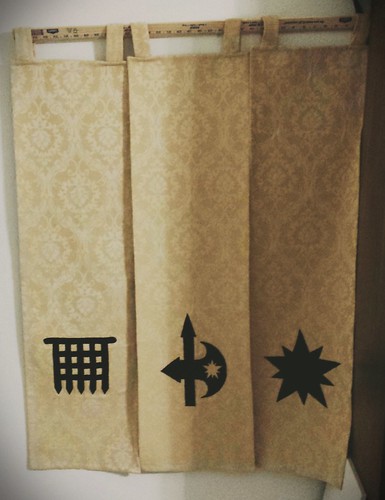
Populace banners with attached hanging loops!

Three banners finished stitching with hanger loops attached! I'm currently finishing up the last one and then I will have two full sets of three. Next I need to come up with a hanging pole arrangement that is slightly nicer than the yardstick I had hanging around the sewing area.

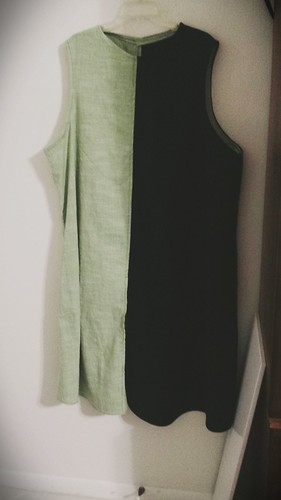
Surcoat for fighting

I knocked out a quick linen fighting surcoat for a friend. It's another project in my continued theme of reducing the fabric stash.

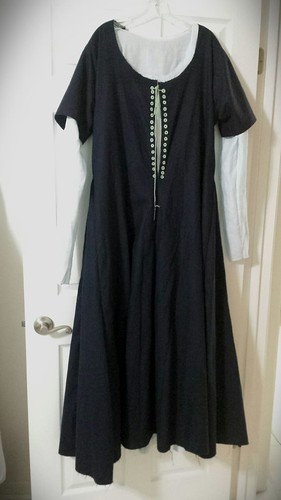
Preview of latest outfit.  It still needs some more sewing.

And last, but not least, I have a preview of my next outfit. The dress and under dress are assembled but still need finishing on the neckline and hem. It's kind of hard to see in the picture, but the dress is dark blue, the under dress is light blue, and the eyelets+lacing are in light green.

Friday, August 15, 2014

Hemming Populace Banners

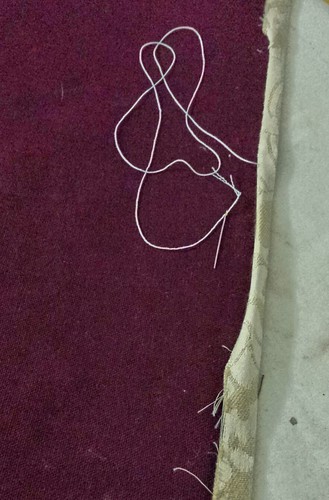
Stitching in the canvas backing on the populace banners

I've been busy, but there's not lots of pretty pictures for hemming six banners. I snip, clean off threads, roll the brocade, stitch, and repeat. I am currently hemming banner number five, so there is an end in sight. Well, an end to hemming anyway. I will still need to cut and sew the loops to for the banners to hang from. I've also begun plotting banner stands, so that I can display them. Progress!

Sunday, March 23, 2014

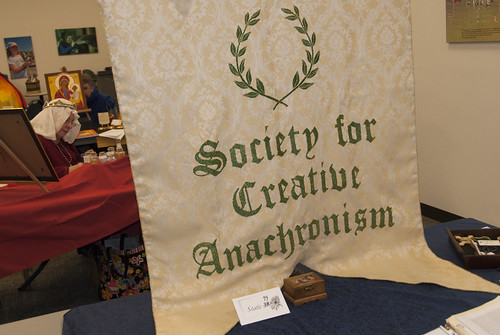
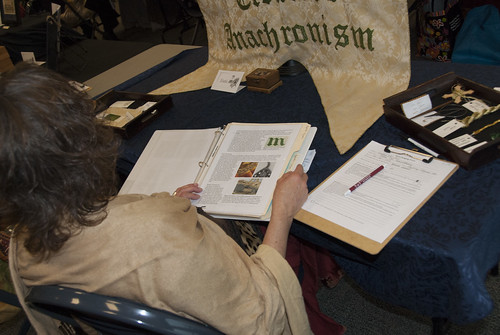
Giant Sparkly Banner on Tour

KingdomAnS-109

KingdomAnS-110

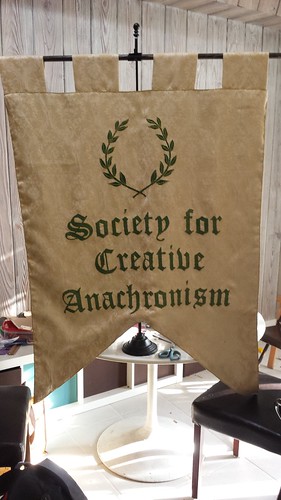
Giant Sparkly Banner made a trip to Kingdom A&S and to Bryn Gwlad A&S competitions. Above are pictures of it in action. Below is a picture of the banner completed getting ready to go traveling.

banner

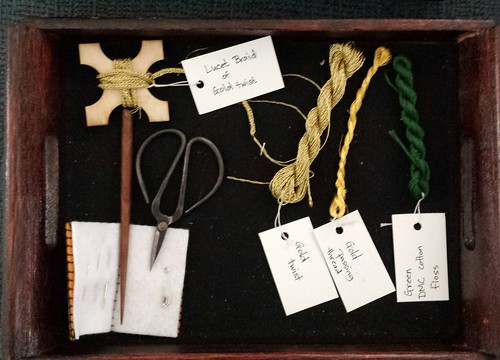
My display used two trays: one for materials and one for technique. The materials tray contained my tools including scissors, needles (in the needlebook), and a laying tool. I made skeins with the threads I used in the green, the passing gold, and the gold twist. Finally, I included a sample of the gold twist lucet cord, which I stored on a thread winder.

tray 2

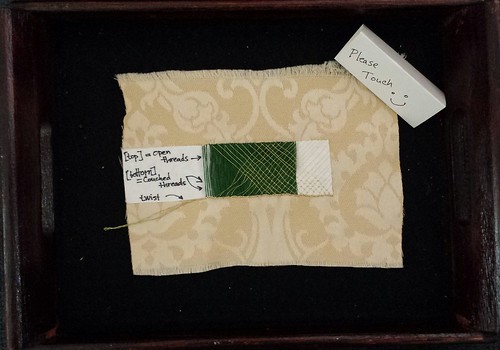
The second tray displayed the various steps for the embroidery. The two fill patters were embroidered in a series of steps

  1. Foundation: The foundation layer is the white interface foundation which was cut to design and ironed on the brocade. In the sample the white layer is shown at either end of the swatch.
  2. Laid green stitching: The green threads were laid down for full coverage of the foundation. The stitch length for the green thread is much longer than most embroidery stitches because it will be couched down later. You can see in the picture that the green thread drifts and wiggles where there are no layers above it.
  3. Laid gold stitching: The next layer was gold passing thread embroidered in laid work pattern, which was on top of the green embroidery. The letters were embroidered in open laid work using a grid pattern. The leaves of the wreath was patterned after Gabriel's wings from an alter frontal so the only laid work was the single gold twist thread along the center. The top half of the sample shows the laid gold threads before they are couched. There is still some shifting of the gold and green threads and the sheen is at a uniform angle.
  4. Couching:After the laid work is finished, the gold pattern (grid or wing/leaf) was couched down. For the grid pattern on the letters, each intersection is couched with a single stitch of gold passing thread. For the wing pattern on the leaves of the wreath, the center gold twist is couched with a longer stitch at an acute angle. The leaves have fewer couching stitches, but the stitches are longer and cover more of the green thread. The bottom half of the stitching in the sample shows the grid with the intersection couched down. The couched intersection gives the work a more dimensional look which adds more sparkle. On the far right end of the swatch you can see the grid couched down without the green layer, to show the couching stitches more clearly.
  5. Outline: The final step for each embroidered motif was to add an outline of couched gold twist. The sample shows the gold twist couched on the bottom of the foundation layer. On the right side of the swatch, the end of the twist has been plunged (pulled through the brocade) as is normally done on finished embroidery. This is a good example of why the foundation and brocade combination work so well. The foundation provides stability for the couching stitches, which the looser weave of the brocade allows the much thicker gold twist to be pulled through to the back without creating tears or runs in the weave. The left side of the swatch shows the gold twist left loose on the top, which is what it looks like while it is being couched. You can immediately see that the biggest challenge here is holding the thread in place for stitching, while trying to keep the twist and prevent fraying of the top threads.

tray 1

Friday, August 13, 2010

Embroidery frame mod

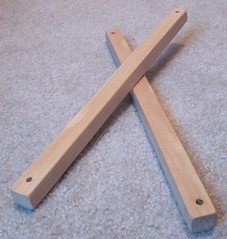
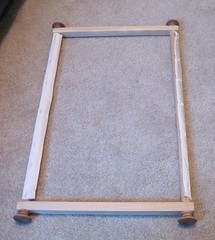
I've been wanting to do a full panel of the German brickwork and I now finally have the time to sit down and get it started. I did some math and most of the panels that I've got good information on are somewhere between 10 inches square (ish) and 12 inches square (ish). My embroidery frame only has an 8inch height and I wanted to put the full panel on the frame without lots of rolling and un-rolling as I stitch. The problem was easily fixed with a piece of 3/4 inch square hardwood from the crafters pile at the hardware store.


BeforeEmbroidery frame before modification (8 inch height)
Stretcher BarsI got Rachel to drill a couple of holes and make the cutes. I took the bars back to my garage and finished them up so they'd be pretty.
AfterFinished! A larger frame :) The finished height is 13 inches.