Showing posts with label kydex. Show all posts

Thursday, May 29, 2014

Pouncing Armor!

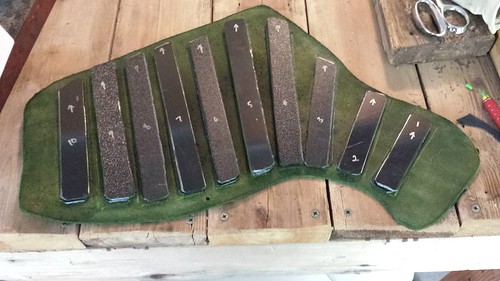
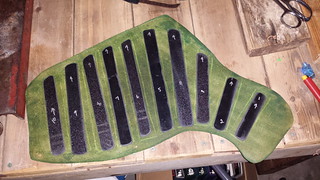
Lining up the splints on my leg armor.   They have now been sized and ground smooth

When we last left my leg armor, I was getting the splints together.  After cutting them out on the Beverly shears, I handed them off to Master Jovian.  He was kind enough to grind the edges smooth for me.  Above you can see the now not-jagged splints ready to go.
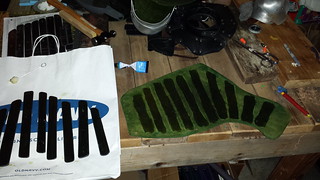
Contact cement to hold things together while I do the riveting

I hate getting rivet holes to line up and dealing with plastic and leather shifting about, so I have decided to eliminate the problem with copius amounts of contact cement.  The contact cement probably wouldn't survive fighter practice, but it will hold things together long enough for me to drill and rivet with minimal fuss.  Here is my sticky, gooey progress.
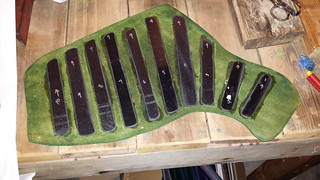
All glued together!

Once the contact cement cured, I placed all the splints in their proper position.  This felt a bit like a surgical procedure, since one false move and the plate is stuck forever.  Well, probably not forever, but there is no wiggle room with dropping the plates.  Contact cement does it's job well and the one splint that I tried to re-position would not budge even the slightest.

Some of my projects have extensive plans that go into great details.  Many have "the magic happens here" steps that lead to creativity, innovation, and occasionally weeping.  For some reason, my magic step here was "do the other leg".  Since I had done all the plate positioning directly on the first leg I didn't really have a pattern to work with.  What to do?  The answer was prick and pounce - armor style!
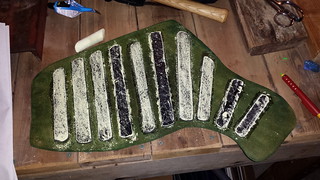
Sidewalk chalk for copying pattern

I borrowed my son's sidewalk chalk and used it to make maximum mess on the splint plates.  The plates with the texture side up did a much better job of being chalky, but the smooth plates did adequate.  When all the splints were thoroughly dusted, I carefully lined up the two pieces, flipped them over, pressed down carefully (no shifting!), and then removed the chalked piece.
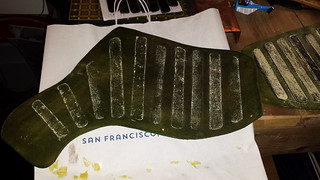
Copying success!

The result was a magnificent success!  I was hoping for it to work well enough for a fiddly approximation, but the copy was perfect!  After the surprisingly effective pattern transfer gluing the second leg was a breeze.  

Tuesday, April 8, 2014

Leg armor progress

Legs are partially assembled

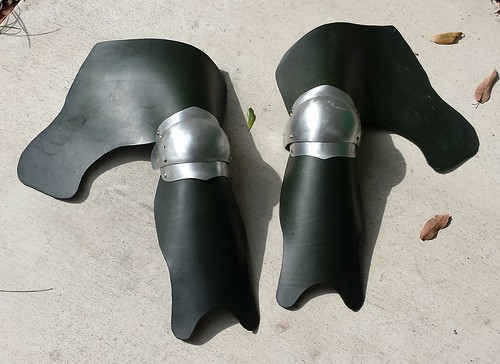
I've resumed work on upgrading my armor, starting with the legs that I was working on. The pieces had been previously cut and dyed, and then laid on a shelf where they weren't doing much of anything. So, this weekend I decided to make some progress. I punched rivet holes and gave them a nice coat of neatsfoot oil. The oil darkened the green dye a bit, but greatly improved the handling and feel of the leather. In the picture above you can see the legs partially assembled with the knee cops.

beverly shears and kydex

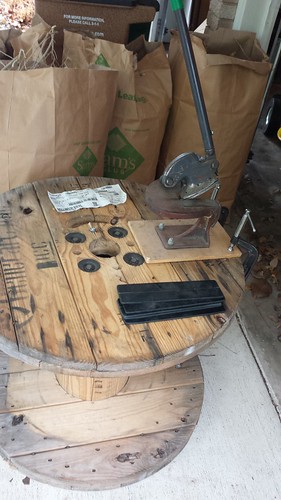
I borrowed some beverly shears from a friend of mine and got to work cutting out plates for splinting the thighs. I've mounted the shears using some C-clamps onto a wooden spool that I picked up for $5 from the electric company. The spool is heavy enough to be sturdy, small enough to fit in the back of my micro van, and the round shape makes it relatively easy to move around. This setup worked really well and I got all the plates for the thighs cut out.

Thigh armor splints cut out

And here is what two sets of thigh splints look like after they are pattern drafted, cut, and laid out. I still need to grind the edges, since they are a bit rough in places.

Dagging edges are painted

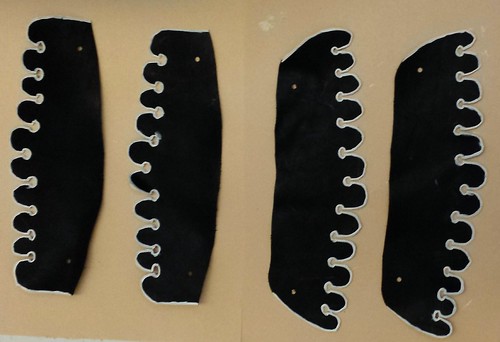
What armor kit would be complete with out some fashionable bling? Ok, it's 14th century fashion, but still - fashionable. I pulled out some thinner black leather and cut dagging strips for my knee cops. The black helped contrast against the green, making it appear less dark. I decided that the contrast needed a bit more zing, so I painted a white border around the edges of the dagging. It looks even nicer than I imagined! As an added benefit the paint sealed the leather on the edges and made the dagging cuts look more tidy.